Blue Schools
After 3 years of development, Blue Schools Aotearoa has officially launched in Christchurch. The 2026 pilot is working with two schools and hundreds of students, using ocean literacy, marine science and experiential learning to inspire the next generation of ocean stewards.

Our Vision
We want young people to understand the ocean’s influence on us, our influence on the ocean, and how their own choices and actions can shape the future of the environments and communities they live in. After three years of development, we have created and launched a uniquely Aotearoa-based programme that blends science, mātauranga Māori, creativity, and hands-on exploration.
Grounded in partnerships across Waitaha Canterbury, the programme helps Year 5/6 and 7/8 students build meaningful, personal connections with their local environments. By integrating ancestral, Indigenous, and scientific ways of knowing, we aim to grow confident, curious learners who feel empowered to contribute to the wellbeing of the moana and their own communities.
The Blue Schools Pilot (2026–2028)
In 2026, Blue Schools officially launched with two schools in Waitaha Canterbury, marking the beginning of a three-year pilot programme. Developed in partnership with teachers, communities, iwi, marine practitioners and education partners, the programme is designed to be engaging, culturally grounded, and aligned with Aotearoa New Zealand’s refreshed science curriculum.
Over the next three years, the pilot will continue to evolve as we test, refine and strengthen the programme, with the ambition of expanding the network and developing a scalable model for other schools and regions across Aotearoa.
What the Programme Delivers
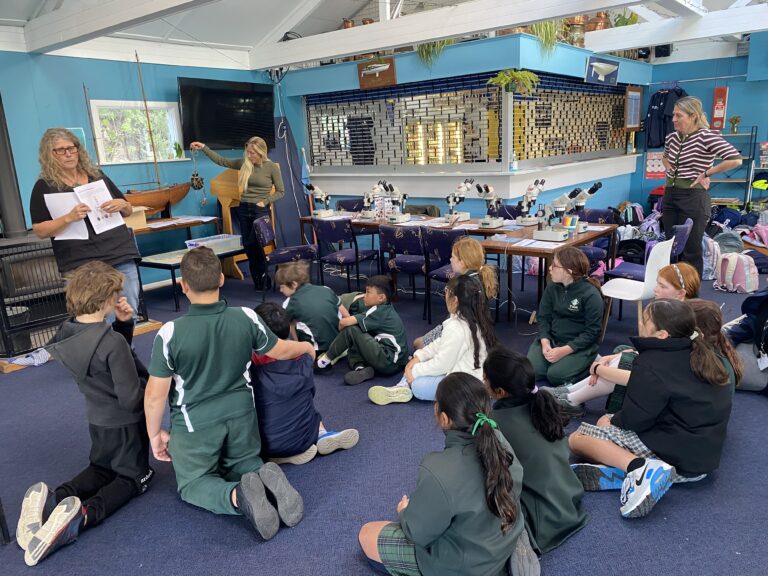
Each term, participating schools take part in a structured learning sequence combining classroom sessions, field experiences, and supporting online resources. This blended model helps students build strong foundations, develop practical skills, and form deeper connections with their local environment.
Three 90-Minute Classroom Sessions (per term)
Each term includes three facilitated 90-minute sessions delivered by our team alongside classroom teachers. These sessions introduce core themes through interactive, inquiry-led learning. Students take part in:
• Hands-on experiments and demonstrations
• Multimedia storytelling based on local case studies
• Exploration of ecological, cultural, and scientific perspectives
• Group investigations that lead into the term’s field trip
This structure builds knowledge, confidence and curiosity before students head into the field.
One Field Trip (per term)
Each term includes a field experience connected to the school’s local environment—coastal areas, river systems, estuaries, or community sites. These trips allow students to:
• Observe local freshwater or marine ecosystems
• Meet local experts, iwi representatives, or environmental groups
• Take part in simple monitoring, surveying, or creative documentation
• Connect their learning to real places, people, and stories
Field trips vary depending on each school’s location and community priorities, ensuring every experience is locally meaningful.
Online Resources
Participating schools have access to a growing collection of supporting resources, including:
• Videos and marine learning content
• Teacher resources and lesson materials
• Student reflection and extension activities
• Local case studies and partner stories
• Whānau and community resources
These resources complement classroom sessions and field trips throughout the programme.
Building a Model for Aotearoa
The Waitaha Canterbury pilot is serving as a proof of concept for a scalable national model. Over three years we will gather evidence, strengthen partnerships, refine resources, and develop a durable, culturally grounded framework that other regions can adapt and adopt.
Our long-term vision is for every young person in Aotearoa New Zealand to have access to engaging, place-based ocean learning connected to their coastlines, waterways, communities and local knowledge holders—so that both our marine environments and our people can thrive for generations to come.
Supported by